
Common questions about electronic logging devices (ELDs)
Your business isn’t a trucking company. But if you rent commercial vehicles that cross state lines, your company must comply with federal rules. One of the most important and misunderstood regulations is the electronic logging device (ELD) mandate.
Do I need an ELD for a Commercial Rental Truck?
While some commercial rentals will need an ELD, others may not. Factors like the vehicle’s weight, driving distance, and the length of the rental contract all play a role in determining which rental trucks need an ELD and which ones don’t.
What is the ELD Mandate?
The ELD mandate is a Federal Motor Carrier Safety Administration (FMCSA) rule that was published in February 2016, with a compliance date of Dec. 18, 2017. The mandate requires operators of specific commercial motor vehicles (CMVs) to track their Record of Duty Status (RODS) and Hours-of-Service (HOS) electronically instead of using paper logs.
How Does the ELD Mandate Apply to Rental Trucks?
The ELD ruling applies to any driver operating certain types of rental vehicles for interstate commerce. The mandate applies if the vehicle has:
- An actual or rated weight of 10,001 pounds or more (single or combination)
- More than 8 or 15 passengers (depending on compensation)
- Any amount of hazardous materials requiring placarding
If your rental truck checks any of these boxes, it’s your company’s responsibility to ensure the vehicle has an ELD.
What Exempts Rental Trucks From ELD Compliance?
There are a few limited exemptions to the ELD mandate related to rental trucks. They include:
Short-term rental exemption
Businesses located in the U.S. that rent trucks for eight days or less can record RODS and HOS status with paper logs rather than ELDs. To use this exemption, drivers must carry copies of:
- Federal Register Notice (FRN) 82 FR 47306 or an equivalent signed FMCSA exemption document that can be provided to a safety official upon request
- The signed rental agreement clearly identifying the parties, vehicle and rental dates
- The driver’s RODS for the current day and the prior seven days if required on those days
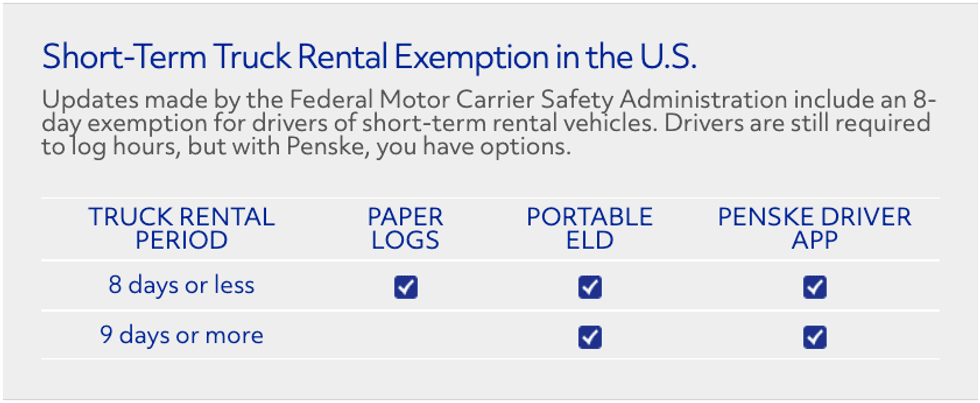
For businesses in Canada, the short-term rental exemption period is 30 days.
Short-haul exemption
Short-haul drivers with a Commercial Driver’s License (CDL) operating rental trucks within a 100-air-mile radius are not required to use an ELD, nor are non-CDL drivers operating commercial rental vehicles within a 150-air-mile radius. Wondering whether your drivers need a CDL to operate a rental vehicle? Check out this CDL vs. non-CDL guide.
Additional exemptions include drivers who conduct drive-away/tow-away operations and drivers of pre-2000 model-year trucks.
Which Penske Rental Trucks Require an ELD for Interstate Commerce?
Heavy-duty tractors, refrigerated trucks, flatbed trucks and semi-trailers from Penske weigh more than 10,001 pounds empty and will need an ELD if your drivers are crossing state lines. The same is true for medium-duty truck rentals, including step vans and 22- to 26-foot box trucks.
Light-duty truck rentals, including smaller box trucks, delivery trucks with shelves and cabover trucks, may require an ELD depending on the weight of the payload.
Cargo vans are lighter-weight rental vehicles that typically do not require an ELD.
ELD Rental Truck Compliance Dos and Don’ts
Maintaining ELD compliance goes beyond outfitting a truck with a logging device. These dos and don’ts can help you meet the full intent of the ELD mandate for rental trucks participating in interstate commerce.
DO confirm the truck’s Gross Vehicle Weight Rating (GVWR) before departure. If it’s 10,001 or more, an ELD is required.
DO know the duration of all rental contracts. If your rental agreement runs for more than eight days, you’ll need an ELD. Always keep a copy of your rental agreement inside the truck.
DO carry paper logs as a backup. If you qualify for any ELD exemptions, use paper logs and keep your rental agreement and FRN exemption document in the vehicle so you can present them to safety officials as needed.
DO log RODS for the current day and, if applicable, the prior seven days.
DON’T assume all rentals are ELD-exempt. If you’re uncertain whether your rental vehicles must comply with the ELD mandate, ask your commercial rental vehicle partner.
DON’T let the short-term (8-day) rental exemption expire without switching to an ELD.
DON’T fail to maintain RODS. All drivers of CMVs weighing 10,001 pounds or more and crossing state lines must record their status (off-duty, sleeper berth, driving, on-duty not driving), date, time zone and other pertinent information per FMCSA requirements.
How Does My Fleet Benefit From ELD Compliance?
Using ELDs allows your fleet to maintain compliance and avoid fines. ELDs also keep your dispatchers updated on a driver’s status, helping ensure proper route planning that aligns with HOS regulations. Drivers benefit from ELDs, too, because ELDs reduce the time and effort required to keep paper logs.
When businesses don’t comply with the ELD mandate, they could face fines and have their drivers or vehicles placed out of service. Noncompliance can also add points to a carrier’s Compliance, Safety, Accountability (CSA) score.
While the ELD mandate is important, it’s just one regulation your company must abide by if it rents motor vehicles. Here’s a look at other DOT and FMSCA requirements.
How Penske Truck Rental Simplifies ELD Compliance
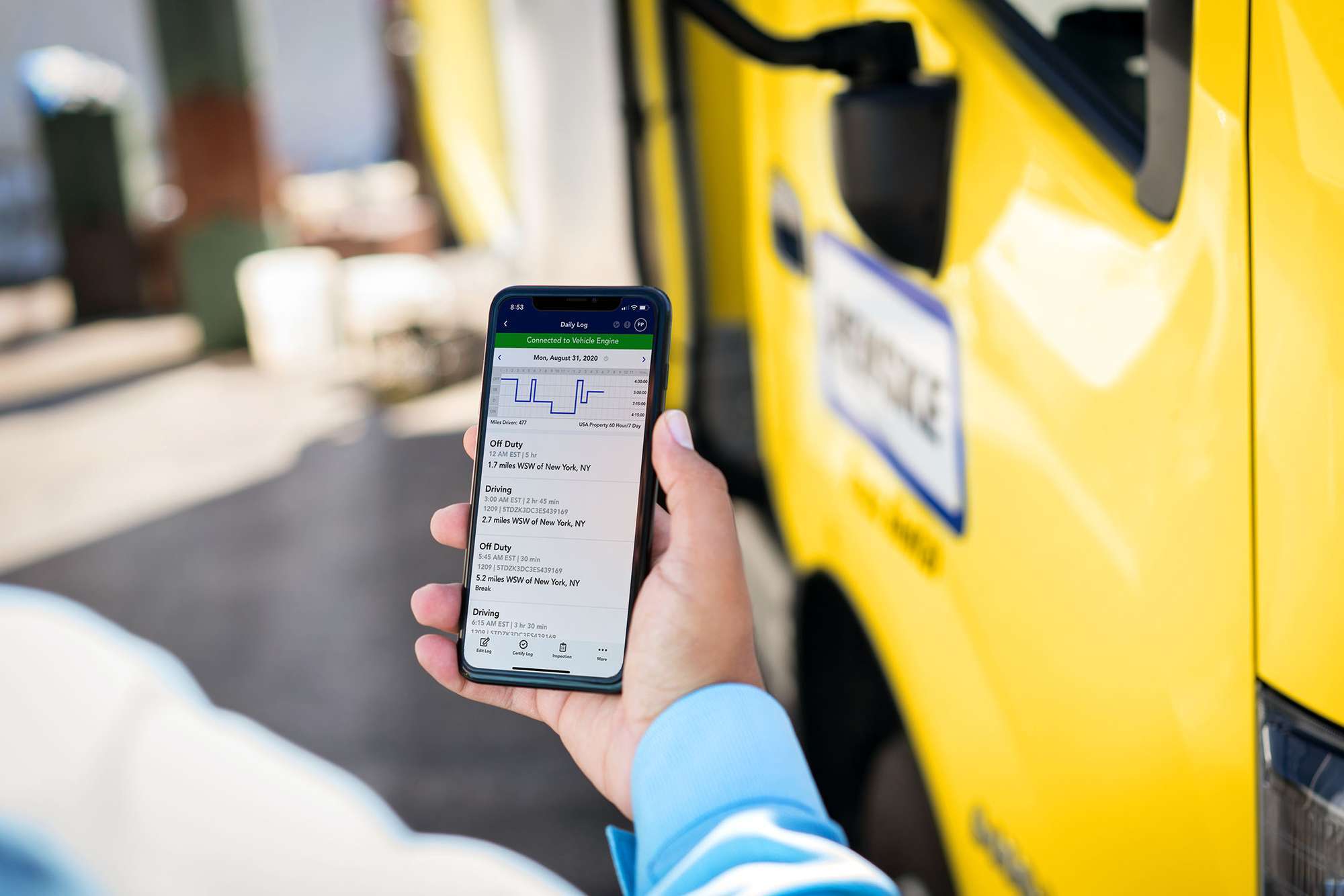
Penske permits drivers and fleets to bring and use their own portable ELD systems in rental vehicles. Fleets can also use the Penske Driver™ app for free. The app uses Bluetooth inside Penske rental trucks to synchronize with the vehicle’s engine and meet both U.S. and Canadian ELD mandates.
Operators of CMV rental trucks can use Penske Driver to log their RODS and HOS. The app also lets drivers request 24/7 roadside assistance, complete electronic driver inspection reports (eDVIR) and submit fuel receipts digitally. In addition, drivers can use the app to find nearby rental, service, parking, EV charging and fueling locations. It’s available for download in the Apple App Store and Google Play store.
Stay ELD Compliant Across Every Mile
Rules like the ELD mandate can be complicated, but they’re essential in keeping drivers and fleets protected. If you have any questions about whether your rental vehicles need an ELD, just ask. Your Penske rental associate will be happy to help you assess your options and choose the right truck for your business.